

Timelines of Fritzlar's town history

Frans Hogenberg (1535–1590), copperplate engraver and etcher, created an impressive view of Fritzlar in the 16th century with a colourised etching. The vignette on the left shows the coat of arms of the Elector and Archbishop of Mainz, Daniel Brendel von Homburg (1555–1582), in a laurel wreath. On the right is an empty shield for the coat of arms of Fritzlar, which was unknown to the artist.
Foreword
One of Fritzlar's most valuable treasures is its eventful 1300-year history. Fritzlar has experienced eventful and turbulent times.
Boniface, the Anglo-Saxon missionary and archbishop, felled the oak tree dedicated to the Germanic god Donar under the protection of the Franconian border fortress of Büraburg. He used the wood to build a house of prayer and founded a Benedictine monastery. The establishment of the settlement of Fritzlar can be traced back to the work of Boniface.
With imperial diets, synods, a coronation and visits by German emperors and kings, Fritzlar gained historical significance in the Frankish and East Frankish Empire and in the formation and development of the Holy Roman Empire of the German Nation.
Under King Henry IV, Fritzlar became a Mainz exclave in Hesse.
In the centuries that followed, the town's history was shaped by its affiliation with the Electorate and Archbishopric of Mainz. The expansive territorial policy of the archbishops and electors led to military conflicts with the Landgraves of Thuringia and Hesse.
The town's most significant building is still the imposing four-nave Romanesque-Gothic Basilica of St. Peter. It bears witness to Fritzlar's prominent position in the Middle Ages.
The electors expanded Fritzlar into a Mainz stronghold. Fritzlar became a fortified, defensible town.
Fritzlar achieved economic prosperity in the 13th and 14th centuries. Trade in wool, cloth and grain flourished. The Michael Brotherhood engaged in long-distance trade as far afield as Flanders and Russia.
The three medieval wars, the Thirty Years' War, the Seven Years' War and the plague brought death, misery and suffering to the town and its citizens.
The Reformation and Counter-Reformation led to unrest and expulsions in the 16th century.
Fritzlar was largely spared during the First and Second World Wars. The historic buildings survived intact.
In the 20th century, Fritzlar developed into an economic centre in the Schwalm-Eder district of northern Hesse.
The timelines provide an overview and insights into the history of the cathedral and imperial city, which can be explored in more depth during a visit to the city museum and on guided tours of the city.
Fritzlar, in the year 2025
Timeline 1: 3rd millennium BC to 782
Prehistoric Settlement of Northern Hessen
3rd millennium BC
The Stone Chamber Tomb
near Fritzlar-Züschen

The Stone Chamber Tomb in Fritzlar, near the district of Züschen, was the burial site of a prehistoric settlement community. People were buried there for centuries.
The skeletal remains of 27 dead people, 46 skulls and some grave goods were found in this tomb.
It is estimated that 200 to 300 people were buried there. Engraved symbols and pictograms on the wall stones make the burial chamber particularly significant. It is one of the most important prehistoric archaeological sites in Central Europe.
The rectangular burial chamber, which is sunk into the ground, is 20 metres long and 3.50 metres wide.
The long walls consist of two rows of 12 rectangular sandstone slabs each, one of which is missing. One slab each bordered the narrow sides.
A closing slab with a circular soul hole 50 cm in diameter separates the burial chamber from an antechamber
See: Kappel, Irene: "Das Steinkammergrab von Züschen (The Stone Chamber Tomb of Züschen) - Guide to Archaelogical Monuments in Germany, Volume 8, Der Schwalm-Eder-Kreis", Konrad Theiss Verlag Stuttgart, 1986, S. 106-111
7th/8th century AD
The Franconian Büraburg

The castle is strategically situated on the Büraberg, overlooking the Eder River, approximately 3 km west of Fritzlar.
Archaeological finds confirm that this prominent rise was inhabited as early as the Neolithic period.
The plan depicts a castle complex featuring an interior area of about eight hectares, a mortared wall, towers, two gates, and the Church of St. Brigida at its center. Outlying ditches and ramparts are shown in blue to the west and east.
This early medieval frontier fortress was built to provide protection against the hostile, pagan Saxons.
The merovingian Church St. Brigida

The church stands at the centre of Büraburg and, with its original masonry, is one of the oldest churches north of the Limes.
From 741 to 755, it was the bishop's church of the Hessian diocese of Büraburg under Witta, who was appointed by Boniface.
See: Lecture by Bärbel Berghus on 08 September 2019, Open Monument Day in St. Brigida
723 - 1066 AD
723 / 724
St. Winfried-Boniface (673-754)

He chose Büraburg as his missionary base in northern Hesse and felled the Chatti sanctuary, an oak tree dedicated to the Germanic god Donar.
He used the wood from the oak to build a house of prayer, consecrated it to St. Peter and founded a Benedictine monastery (1st abbot Wigbert).
Anglo Saxon, missionary, apostle of the Germans, archbishop

Boniface carried out missionary work in Hesse, Thuringia and Bavaria.
The church and monastery became the starting point for the development of the settlement of Fritzlar.
732
St. Wigbert (670 - 740)
Missionary and companion of Boniface

Boniface appointed Wigbert as the first abbot of the Benedictine monastery in Fritzlar.
Wigbert built the first stone church and founded the first Hessian monastery school, an important training centre for young clergy.
Wigbert died in Fritzlar. His tomb with relics is located in the crypt of St. Peter's Basilica in Fritzlar.
Legend has it that when Wigbert lacked the necessary sacramental wine, he pressed the juice of a freshly picked grape, which turned into wine
742
Büraburg becomes a bishopric

Boniface elevated his compatriot Witta (670–745) to bishop in Büraburg.
The Frankish castle protected the bishopric.
Pope Zacharias (679–752) confirmed Witta's office and consecration in 743.
After Witta's death, the Diocese of Hesse was incorporated into the Diocese of Mainz.
See.: de.wikipedia.org/Witta-von-Büraburg
774
First destruction of Fritzlar
by the Saxons

In 773, Charlemagne set out on a campaign to Italy in support of Pope Adrian I (reigned 772–795) against the Lombards.
The Saxons took advantage of the king's absence and invaded northern Hesse.
Fritzlar was burned to the ground. The stone Romanesque church withstood the attack.
The inhabitants of the Eder region fled to Büraburg and successfully defended the fortress
See.: de.wikipedia.org/Witta-von-Büraburg
See.: Abb.27, in Wigand Gerstenberg von Frankenberg, 1457-1522; Marburg 2007
782
Charlemagne (747–814) presents a deed of donation to the monks of Fritzlar

After the Saxon invasion of Fritzlar and Büraburg in 774, Charlemagne took the monastery and the settlement of Fritzlar into imperial possession and donated land to the monastery.
The monastery was thus placed under the special protection of the king.
Timeline 2: 919 AD to late 13th century
Period: approx. 350 years as part of the Frankish/East Frankish Empire (723–1066); approx. 740 years as part of the Archdiocese of Mainz (1066–1803)
approx. 350 years as part of the Frankish/East Frankish Empire (723–1066)
919
King Henry I. (876 - 936)

On the recommendation of his predecessor, King Conrad I (881–918), Duke Henry of Saxony was crowned King of East Francia by the Saxons and Franks in Fritzlar, an act of historic significance.
At the time, it caused a stir that Henry I declined to be crowned and anointed by Archbishop Heriger of Mainz († 927).
Heriger nevertheless recognised his kingship
Around 1005
Conversion of the Benedictine monastery into the freer St. Peter's Collegiate Church

The collegiate church was headed by a provost and no longer by an abbot.
The canons lived in celibacy for life in their own households, known as curias.
At the end of the 14th century, 18 curias were mentioned in writing.
Many canons worked as academic teachers at St. Peter's Abbey until 1803.
The curia shown in the picture, located in Fischgasse, was built around 1400.
The monastery was dissolved in 1803.
See.: Schulze, Hans, K.: "Das Chorherrenstift St. Peter zu Fritzlar im Mittelalter" (The St. Peter's Collegiate Church in Fritzlar in the Middle Ages) in "Fritzlar im Mittelalter" (Fritzlar in the Middle Ages), commemorative publication for the 1250th anniversary, Fritzlar 1974, p. 152
Around 1066
Fritzlar comes into the possession of Mainz

Under King Henry IV (1050–1106), Fritzlar passed from imperial ownership to the Archbishopric of Mainz.
The 16-year-old Henry IV fell seriously ill in Fritzlar. Archbishop Siegfried I of Mainz (d. 1084) attended to him at his sickbed.
It is believed that the young king rewarded this assistance with a donation to Mainz after his recovery.
approx. 740 years as part of the Archdiocese of Mainz (1066 - 1803)
June 1079
Papal legates negotiate in Fritzlar

The papal envoys negotiated unsuccessfully in Fritzlar with representatives of King Henry IV and the rival king Rudolf of Rheinfelden.
The Investiture Controversy (1076–1122) was a dispute between the emperor and the pope over the right to appoint clergy.
King Henry IV refused to submit to Pope Gregory VII, who excommunicated him. The princes refused to follow Henry.
In the winter of 1077, Henry went to Canossa. He showed remorse and submitted to the Pope. The Investiture Controversy ended in 1122 with the agreement between Pope Calix II and Emperor Henry V in the Concordat of Worms.
Summer 1079
The second destruction of Fritzlar by Rudolf of Rheinfelden

After fruitless negotiations between the adversaries, Archbishop Siegfried I of Mainz († 1084) sided with the rival king Rudolf of Rheinfelden.
King Henry IV stripped Mainz of all its rights in Fritzlar, making Fritzlar a hostile city for Rudolf, who completely destroyed it.
Henry IV was able to flee.

The etching (Bernhard Rode, 1781) shows the seriously wounded Rudolf of Rheinfelden, who was defeated by Henry IV in the Battle of Hohenmölsen in 1080. The hand with which he had once sworn allegiance to Henry IV was cut off.
The bronze tomb slab in Merseburg Cathedral shows the rival king with a crown, orb and sceptre.
1085 - 1118
First construction phase of St. Peter's Basilica

Builders from Worms erected a large, flat-roofed, three-nave basilica with transepts and a straight-ended choir.
Square side choirs with semicircular apses were added to the choir at the end of the construction period.
Large parts of this Romanesque building are still preserved in today's cathedral.
See: Rauch / Katzmann: ‘Fritzlar – Die alte Dom- und Kaiserstadt und ihre Kunstschätze’ (Fritzlar – The Old Cathedral and Imperial City and its Art Treasures), Katzmann Verlag, Tübingen, 1974, p. 7.
From 1100
Medieval town fortifications

As an exclave of Mainz, Fritzlar became a cornerstone of the archbishop's territorial policy.
Mainz promoted Fritzlar and developed it into a military and economic centre. As a result, the archbishops and later electors increasingly came into conflict with the Thuringian-Hessian landgraves. Military conflicts ensued.
In the course of this development, Fritzlar was fortified from the 12th century onwards with a ring wall with gates and defence towers.

In the 14th century, a total of seven watchtowers were erected at the boundaries of Fritzlar as observation posts.
By the 15th century, Fritzlar's city fortifications had become an impressive and strong defensive structure:
- Length of the city wall 2.5 km
- Seven gate towers
- 23 defence towers
- Seven fortified watchtowers in front of the town
- Dry moats in front of the town wall to reinforce the vulnerable north side
During the Seven Years' War, the fortifications were demolished (1761-1762).
The gate towers fell victim to urban planners at the beginning of the 19th century.
Today, the following still remain:

- Parts of the city wall, approx. 2.5 km
- 9 defence towers, including the ‘Grey Tower’
- 5 watchtowers

See: 1. Demand, Karl, E.: ‘Fritzlar im Mittelalter’ (Fritzlar in the Middle Ages), commemorative publication for the 1250th anniversary, 1974, p. 287 ff.
2. Balli, Brüggemeier, Burchart, Leise, Lohmann: ‘Liebenswertes Fritzlar’ (Lovely Fritzlar) Felsberg, 1999, pp. 22-26
1109
Bailiff's and Town Hall in Fritzlar

The bailiff held court for three days each year in the bailiff's house of the Archbishopric of Mainz.
In 1266, the office of mayor was established and the bailiff's house became the town hall.
It is considered one of the oldest administrative buildings in Germany.
1118
Norbert of Xanten (1085 - 1134)
at the Synod of Fritzlar

According to several sources, the official church accused him of preaching without authorisation and behaving in a manner unbefitting his status because he criticised the lifestyle of the clergy.
He successfully defended himself before the papal legate Kuno of Präneste.
In Prémontré, France, he founded the Premonstratensian Order.
In 1126, he was appointed Archbishop of Magdeburg.
See: 1. www.mittelalter-lexikon.de/wiki/Norbert_von_Xanten
See: 2.de.wikipedia.org/wiki/Synode_in_Fritzlar_(1118)
3 www.deutsche-biographie.de
1171 - 1232
Second construction phase of St. Peter's Basilica

Construction defects necessitated a renovation, which gave the basilica its current appearance.
The main choir was extended with a polygonal apse.
The choir, transepts and nave were vaulted.
The Romanesque south aisle was replaced in the 14th century by a Gothic aisle and a Gothic side aisle.
The Gothic St Mary's Chapel, attached to the north transept, also dates from this period.
See.: Rauch / Katzmann, pp. 7-8

On 7 December 1868, a hurricane tore down the south spire, which crashed through the nave. 21 people died.
In 1873, the spires were replaced by two diamond-shaped spires in their current form.
The photo shows the current double-tower west façade with the 13th-century porch.
The fountain (Kump) in front of it served as the medieval water supply. Wooden water pipes leading from the Edermühlgraben to the Kump were found.
On the right is the back of the Bonifatius monument (1999).
1232
Third destruction by Landgrave Konrad of Thuringia (1204 - 1247)

The centuries-long military and political tensions between the Archbishopric of Mainz and the Landgraviate of Thuringia-Hesse led to the siege, plundering and destruction of Fritzlar by Konrad in 1232.
The plundering of the collegiate church had serious consequences for Landgrave Konrad.
Pope Gregory IX (1167–1241) excommunicated him.

Konrad had to finance the reconstruction of the town in order to be released from the ban.
When the Thuringians withdrew, the women ran up onto the walls, lifted their skirts and ‘hung their naked arses over the battlements’. Enraged, the Thuringians turned back and stormed the town.
See.: Balli, Brüggemeier, Burchart, Leise, Lohmann: "Liebenswertes Fritzlar" (Lovable Fritzlar),op. cit., 1999, p. 11
1237 - 1244
Franciscans (Minorites) establish
a monastery in Fritzlar

Eleven years after the death of the order's founder, Francis of Assisi,
the Minorites established their settlement in Fritzlar and built their monastery.
Archbishop Siegfried III of Mainz (1194–1249) supported the project.
The monastery existed until 1811.
See.: Ellwardt, Kathrin: "Vom Minoritenkloster zur Evangelischen Stadtkirche" (From Minorite Monastery to Protestant Town Church) , October 2001, pp. 10-11, 19
1260
Fraumünster Church

Surrounded by a high stone wall, the church stands east of the town of Fritzlar and belongs to the district of Obermöllrich.
The name means that the church is dedicated to the Virgin Mary (Frau).
The word ‘Münster’ is derived from ‘monasterium’, which means monastery.
The nave features Romanesque masonry in the south wall.
In 1676, the church was given a half-timbered structure with a ridge turret.
End of the 13th century
Augustinian nuns in Fritzlar

In 1254, Augustinian nuns built a convent and hospital for the poor on the southern slope of the basilica outside the city walls. Half a century later, they built St. Catherine's Church, which still stands today. The convent was dissolved in 1538.
In 1711, three Ursuline nuns founded a new convent in Fritzlar.
The foundation stone for the new convent building was laid in 1713, with a school and boarding school for girls.
The school still exists today under the name Ursulinenschule Fritzlar.
Timeline 3: 1308 to 1821
approx. 740 years as part of the Archdiocese of Mainz (1066 - 1803)
1308
Holy Spirit Chapel and
Hospital on the Mill Ditch

In 1308, the town of Fritzlar built a municipal hospital (care facility) with a chapel outside the town walls on the flowing waters of the mill ditch.
During the Reformation, Jost Runke preached to Protestants in this church.
In 1824, the hospital was moved to the disused Minorite monastery at the Protestant town church.
This developed into today's ‘Hospital zum Heiligen Geist’ (Holy Spirit Hospital)
Around 1330
Construction of the Minorite Church

The Minorite Church of the Franciscan monks was completed in the first half of the 14th century. Their monastery existed until 1811.

The church is a Gothic hall church with an asymmetrical side aisle and tracery windows that provide plenty of light.
As a mendicant order church, the builders and architects developed a simple architectural style without a transept or tower, in contrast to the monumentality of Gothic cathedrals .
See: Ellwarth, Kathrin: ‘From Minorite Monastery to Protestant Parish Church’, October 2001.
13th and 14th centuries
St. Michael's Brotherhood

One of the most beautiful late medieval half-timbered houses on the market square is the office building of the St. Michael's Brotherhood, built between 1475 and 1480.
On the central pillar, there is a sculpture of St. Michael fighting evil with his flaming sword.

Michael is the patron saint of merchants, and the brotherhood of respected citizens was named after him.
The merchants dominated the economic and political life of the city .
They were active as wholesalers and maintained relationships as far afield as Flanders and Novgorod in Russia.
The brotherhood was dissolved in the mid-19th century.
Today, the building is used as a residential and commercial building .
1348 / 1483
The plague in Fritzlar
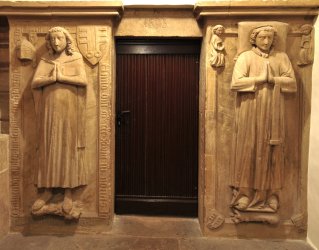
The plague raged several times in Fritzlar, claiming the lives of large parts of the population.
At the entrance to the crypt in St. Peter's Cathedral, the tombstones of two brothers who both died in 1348, the year of the great plague, are displayed.
Left: Knight Johann von Falkenberg.
Right: Hermann von Falkenberg, who, as a clergyman, wears a chasuble and a maniple over his left arm.
1427
Mainz-Hesse War

In the battle for supremacy in Hesse, the armies of Landgrave Louis I of Hesse (1402–1458) and Archbishop Konrad III of Mainz (1380–1434) fought near Fritzlar and Fulda.
Ludwig's victory meant that Fritzlar lost its leading role in Lower Hesse.
The Landgraves of Hesse took the dean and chapter of St. Peter's Church in Fritzlar under their protection in return for a ‘defence fee’.
From 1523 onwards
Reformation in Fritzlar

Martin Luther (1483–1546), Augustinian monk and reformer, shook up ecclesiastical and social life in the German Empire.
Fritzlar became Protestant, with the exception of St. Peter's Cathedral and the monastery. The Counter-Reformation of the Catholic Church (1545–1648) brought renewed unrest.
After the Peace of Augsburg in 1555, Fritzlar became Catholic again and remained a Mainz exclave in the Protestant Landgraviate of Hesse
Elector and Archbishop of Mainz Daniel Brendel von Homburg (reigned 1555–1582) promised tolerance to the Protestants in Fritzlar.
From 1559 onwards, there was a period of tolerant coexistence
See: Lohmann, Paulgerhard: 'Reformation in Fritzlar 1521-1648', Books on Demand, Norderstedt, 2004

Wigand Güldenapf from Fritzlar (1470–1533) was the Latin teacher of the young Luther in Eisenach. Güldenapf was highly regarded by Luther.
When Güldenapf's pension payments were not made, Luther wrote a letter to Prince Johann Friedrich of Saxony in 1526 on his behalf.
There is a Wigand Güldenapf room in the Martin Luther House in Fritzlar
1564
Roland Fountain on Fritzlar Market Square

It was built in 1564 in Renaissance style with a diameter of seven metres.
The column with gargoyles and coats of arms bears the figure of Roland with a shield and flag lance as a sign of royal protection of the market.
The water was pumped from the millrace to the fountain through wooden pipes.
One such pipe is preserved in the town museum
1580 / 1590
Wedding House
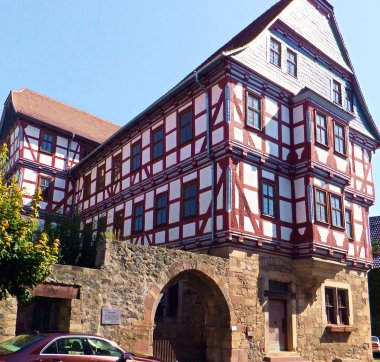
The building originally belonged to a farmyard belonging to Haina Monastery.
One of the largest half-timbered houses in Hesse, it was built as a festival hall for the citizens of Fritzlar. Later, it was used as a warehouse, military hospital, barracks, residential building and school.
After 1956, it housed a museum of prehistory, early history, folklore and city history.
Between 2018 and 2022, it was renovated and redesigned as a museum of city histor.
See: Lohmann, Clemens: ‘Dom- und Kaiserstadt Fritzlar’ (Fritzlar, Cathedral and Imperial City), Fritzlar City Council, 2005
1618 - 1648
Thirty Years' War

Multiple occupations, partial destruction and looting devastated the town's economic power. The population fell from around 2,500 to around 400 inhabitants.
Imperial troops under Prince Piccolomini entrenched themselves in Fritzlar, while Swedish troops under General Banér advanced between Züschen and Dorla.
There were isolated skirmishes, but no battle took place.
The Swedes retreated towards Wildungen.
The imperial troops withdrew to Wolfhagen and Warburg.
Hesse-Cassel was reformed, while Hesse-Darmstadt remained Lutheran.
See.: Balli, Brüggemeier, Burchart, Leise, Lohmann: "Liebenswertes Fritzlar" (Lovable Fritzlar), Druckerei Karl Strube, Felsberg, 1999, p. 33
1761 -1762
Looting and destruction during the Seven Years' War
In the power struggle between the major European powers, Fritzlar was occupied by French troops.
In February 1761, Brunswick soldiers bombarded the town with cannons.
The defeated French surrendered and were allowed to leave freely.
Walls and towers were severely damaged. The town fortifications were demolished. Fritzlar was no longer a ‘stronghold’ in military terms.
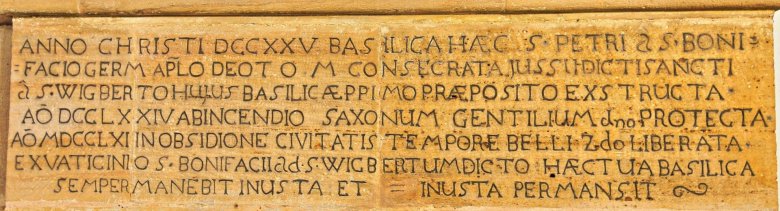
A Latin inscription is carved into the south wall of the main crypt of the cathedral. The translation reads:
In the year of Christ 725, this Church of St. Peter was consecrated to the Holy Trinity by St. Boniface,
the Apostle of the Germans, and built on behalf of St. Boniface by St. Wigbert, the head of this church.
In 774, it was saved from being pillaged by the pagan Saxons for the first time.
In 1761, it was saved for the second time during the siege of the city in the war, according to the prophecy given by St. Boniface to St. Wigbert: This church of yours will always be spared from fire. And it was spared.
Whether this inscription can be considered historical truth, given the tension between facts, interpretations and myths, remains to be seen.
See: 1. ‘Liebenswertes Fritzlar’ (Lovable Fritzlar), p. 13; 2. Niederquell, Theodor: ‘Die Inschriften der Stadt Fritzlar’ (The Inscriptions of the City of Fritzlar), 1974, p. 16
1803
Recess of the Deputation of the Empire

This law compensated secular princes for their territorial losses to France on the left bank of the Rhine with ecclesiastical principalities.
The Electorate of Hesse-Cassel (1803–1866) received Fritzlar, among other territories.
The Peterstift was abolished in the course of secularisation.
The illustration shows the decree of Landgrave William IX of Hesse-Kassel (1743–1821) dated 14 September 1802.
In it, the Landgrave decrees the seizure of Fritzlar. At the same time, he assures the people of his paternal benevolence, care and protection.
1811 / 1817
Minorite Church becomes Protestant parish church
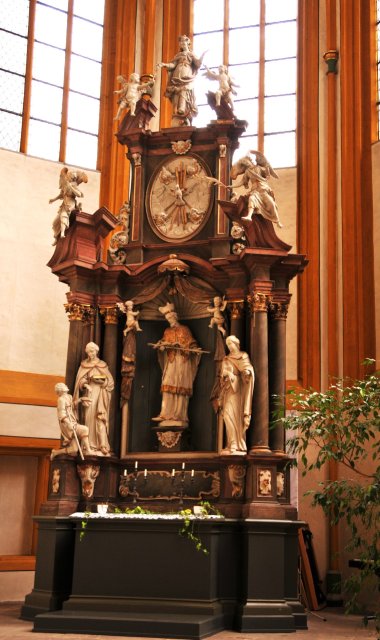
Jérome, King of Westphalia (reigned 1807–1813), dissolved the Minorite monastery in 1811.
In 1817, Elector William I of Hesse-Cassel (1743–1821) handed over the monastery church to the Protestant community in Fritzlar.
The Nepomuk altar from 1735 has been in the choir since 1982. St. John Nepomuk takes centre stage in its retable. To his left is St. Elizabeth, giving alms to a needy person. To his right is presumably St. Anne with a book in her right hand. The altarpiece is crowned by St. Mary.
800 years of church history are reflected in the architecture and interior design of Fritzlar's town church.
See.: Ellwardt, Katrin: ibid.
1820 - 1830
Painter's Corner

The millrace offers a special view of the medieval bridge, the Winterturm tower and St. Peter's Cathedral.
Ernst Metz's painting depicts an idealised view of Fritzlar in the first third of the 19th century.
Hussars from Kurhessen ride across the bridge. They were stationed in Fritzlar from 1815 to 1831.
See.: Balli, Brüggemeier, Burchart, Leise, Lohmann: "Liebenswertes Fritzlar" (Loveable Fritzlar), Karl Strube Printing House Felsberg, 1999
1821
St. Peter's Cathedral Parish joins the Diocese of Fulda

As a result of the Imperial Deputation Main Resolution (1803) and the Congress of Vienna (1814–1815), the dioceses in Germany were reformed in 1821.
Since then, the Catholic cathedral parish of St. Peter has belonged to the Diocese of Fulda.
Timeline 4: 1866 to 1974
1813 - 1866 Kurhessen 1871 - 1918 German Empire 1918 - 1933 Weimar Republic 1933 - 1945 to German Reich / National Socialism From 1949, the State of Hesse in the Federal Republic of Germany
1866
Prussia annexes Kurhessen

After the German War (1866), Kurhessen and Fritzlar fall to Prussia.
Since then, Fritzlar has been a garrison town.
A postcard from 1898 shows Fritzlar artillerymen during a combat exercise.
See: Burchart, Lohmann, Opfer: "Fritzlar - Ein Rundgang durch die Stadt in alten Photographien" (Fritzlar – A tour of the town in old photographs) , Wartberg Verlag 1988, p. 12
1823 - 1890 / 1897 - 1938
1823 - 1890 Old Synagogue
1897 - 1938 New Synagogue
Jewish life existed in Fritzlar, Ungedanken, Züschen and other places in the region since the Middle Ages.

The new synagogue was built in Neustädter Straße in 1897. Discrimination and persecution since 1933 culminated in the pogrom of the ‘Reichskristallnacht’ in 1938.
Violent riots broke out against Jewish residents.
Local SA and Arolsen SS members vandalised the synagogue. A memorial plaque in Neustädter Straße commemorates the house of worship and assembly.
A digital reconstruction of the Fritzlar synagogue has been used to create a virtual model that can be experienced in the town museu.

Gunter Demnig's stumbling stones commemorate the fate of Jewish residents who were persecuted, expelled, deported, murdered, beaten to death or driven to suicide during the Nazi era.

The Lioba window was created in 1988 in the south aisle of St. Peter's Cathedral. Monsignor Ludwig Vogel (1920–2014) initiated the window with the nun Edith Stein. As a Jew, she was murdered in Auschwitz concentration camp in 1942.
See.: Lohmann, Paulgerhard: "Der antijüdische NS-Rassenwahn und die Fritzlarer Juden 1933-1940" (Anti-Jewish Nazi racial fanaticism and the Jews of Fritzlar 1933–1940)
1884
Railway connection to the Wabern–Wildungen line

The stagecoach was followed by the railway. From 1884 onwards, travellers were able to take the train from Fritzlar station. Growing passenger and freight traffic promoted economic development; a transport revolution in the 19th century.
The mechanical signal box of the JÜDEL type dates from the 1930s and was operated by the signalman using his own muscle power in the signal box until 2024.

In 2024, the railway line was modernised for Hessentag. The mechanical signal box was dismantled. Today, the points are set by electric drives and the signals are set by the dispatcher in Kassel
Customer dialogue DB Regio Hessen / S-Bahn-Rhein-Main from 05 June 2025
1889
Blaumühle municipal
power station

Electricity production began in Fritzlar with the run-of-river power station on the Edermühlgraben.
A Kaplan and a Francis turbine generate around 1500–2000 MWh/year, which is enough to supply around 600 households today.
Two wells supply Hengstenberg GmbH with industrial water for cleaning the cabbages delivered to the compan.
1933 - 1934
The path to National Socialist
dictatorship

In Fritzlar, the Prussian Municipal Constitution Act enacted in December 1933 ended democratic self-government. The Minister of the Interior appointed the mayor according to the Führer principle, who could make decisions without the municipal council.
The members of the municipal council and city councillors were appointed by the district president on the recommendation of the Gauleiter.
In 1934, the freely elected mayor, Dr Erich Schnitzler, was deposed and replaced by NSDAP member Fritz Heckmann until 1945. The National Socialists, who were supported by many, intimidated the population.
1935 - 1938
Military airfield

The air base was built in the Eder lowlands south of the town of Fritzlar between 1935 and 1938 as part of the National Socialist rearmament of the Wehrmacht.
In 1938, parts of Fighter Wing 254 moved in. (1)
Today, Combat Helicopter Regiment 36 is stationed at the Fritzlar Army Airfield.
(1) Halm, Heinz in: "Soldaten in Fritzlar" (Soldiers in Fritzlar), p. 51, 1974
1946
A democratic new beginning after the end of the war in 1945

In 1945, Nazi Germany surrendered to the Allied powers of the United States, Great Britain, the Soviet Union and France. The victors had liberated Germany from Nazi dictatorship.
Military governments ruled the four occupation zones on a transitional basis. At the Potsdam Conference, it was decided that Germany should be governed democratically.
In December 1945, the Grand Hessian State Ministry ordered local elections on behalf of the American military government.
Three parties were permitted in Fritzlar: the CDU, SPD and KPD.
National Socialist officials were largely excluded from passive voting rights.
The first free local elections in Fritzlar took place on 27 January 1946. The CDU won five seats, the SPD three and the KPD none.
The mayors were CDU members Dr Erich Schnitzler from 1945 to 1946, Julius Kaever from 1946 to 1948 and Emil Geismar from 1948 to 1970.
The Hessian state constitution came into force on 1 December 1946, and the Basic Law of the Federal Republic of Germany on 23 May 1949.
1956
Establishment of the Bundeswehr

After the withdrawal of French troops in 1956, the base command, Grenadier Battalion 22 (later Panzergrenadier Battalion 53) and Tank Reconnaissance Battalion 5 were relocated to Fritzlar in the airfield barrack.
This was followed by :
- the armoured reconnaissance battalion
- the armoured artillery battalion 2
- the military police command
- the defence district command 441
- the anti-aircraft battalion 2
- the long-range reconnaissance company 300
- the armoured engineer company 50
- the location medical centre and the specialist medical centre
- the staff and the staff company of Air Mechanised Brigade 1, later renamed Air Mobile Brigade 1 (1997-2013) )
Army aviators were stationed in Fritzlar from 1957 onwards.
Since 2002, Army Aviation Regiment 36 Kurhessen, equipped with TIGER combat helicopters, has been stationed at the barracks and army airfield.
Changes resulted from the reorganisation into the various army structures.
In 1964, the airfield barracks were renamed Georg-Friedrich Barracks after Prince Georg Friedrich of Waldeck (1620–1692
See.: 1 Halm, Heinz: "Soldaten in Fritzlar - Geschichten einer Garnisonsstadt" (Soldiers in Fritzlar – Stories of a Garrison Town), Fritzlar, Dezember 1974, p. 62-75
See.: 2 wikipedia.org/wiki/Heeresflupplatz_Fritzlar
See.: 3 Preuß, Jürgen: "70 Jahre Flugplatz Fritzlar" (70 Years of Fritzlar Airfield), 1938-2008
1961
Hengstenberg has been producing in Fritzlar since 1961

Fritzlar is located in a rural area characterised by fertile farmland and wooded basalt hills.
Farmers in the region grow white cabbage, red cabbage and cucumbers.
Founded in Esslingen in 1876, the company processes these products with select ingredients and in various forms, exporting them to 40 countries

1971 - 1974
Territorial reform

Fritzlar, district capital since 1821, lost this status with the establishment of the Schwalm-Eder district in 1974.
With the incorporation of ten districts, previously independent municipalities, the population grew to almost 15,00.
At the entrance to the town hall, there is a plaque with the coat of arms of Fritzlar (Mainz wheel) and the names of its district.
It shows the blue coat of arms of the Schwalm-Eder district with three wave bars for Fulda, Eder and Schwalm and the rising Hessian lion, the state coat of arms in a blue shield with a striding lion divided into red and silver, and the federal eagle in a wreath of flowers at the top. On both sides are three blue and white flags, the colours of Fritzlar .
1974
Hessentag

Under Mayor Reinhold Koch, the 14th Hessentag took place together with the celebration of the 1250th anniversary of the cathedral and imperial city of Fritzlar.
With Hessian Prime Minister Albert Oswald (1919–1996) in attendance, around 250,000 visitors enjoyed a festival programme lasting several days.
Hessian Days were established in 1961 by the then Prime Minister of Hesse, Georg-August Zinn (1901–1976).
Timeline: 1975 to 2025
From 1949, the state of Hesse in the Federal Republic of Germany
1975
Fritzlar, a town of schools

Schools play an important role in Fritzlar. As early as the 8th century, Abbot Wigbert (670–746) established a monastery school as a training centre for young clergy.
Over the past few centuries, Fritzlar has developed into an important educational centre offering a wide range of educational opportunities.
The picture shows the former Royal Preparatory School.
Until 1921, students were prepared here for their studies at the Catholic teacher training college in Fulda.
Today, children and young people are taught here at the School at the Cathedral.
1976 - 1996
Old town renovation
and pedestrian zone

From 1976 to 1996, under Mayor Reinhold Koch (1930 – 2017), Fritzlar's old town was systematically renovated. As part of the urban development programme, the unfortunate traffic situation was remedied and historic buildings were renovated.
The B450 federal highway was relocated outside the old town, and a pedestrian zone was created around the market square and Kasseler Straße, becoming a popular meeting place for locals and visitors alike.

The historic cathedral and imperial city is a magnet for visitors.
2022
Hochzeitshaus City Museum
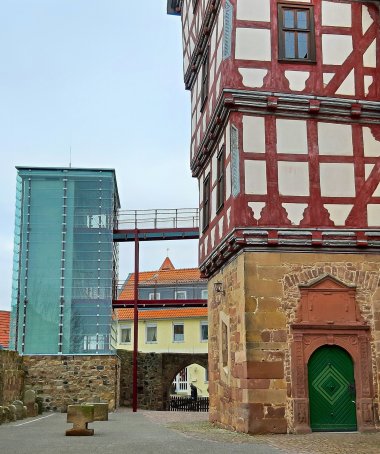
From 2018 to 2022, the historic Hochzeitshaus (1580–1590) and former regional museum was renovated and redesigned as a museum of city history.
The modern rescue tower with lift serves to provide fire protection and accessibility. Architecturally, history now meets the present.
2024: The anniversary year
75 years of the Basic Law (1949–2024)
A milestone in German history

This anniversary provides an opportunity to honour the Basic Law and reflect on German history, political developments and the challenges of the present day.
For twelve years (1933–1945), millions of people were disenfranchised, tortured, murdered, beaten to death and driven to suicide under the reign of terror of National Socialism in Germany.
After the fall of National Socialism in 1945, a new era began with the Federal Republic of Germany.
On 23 May 1949, the Basic Law was promulgated, marking the birth of the Federal Republic of Germany. It guarantees human rights and regulates the organisation of the federal state. Together with the state constitutions, it guarantees the rights of local authorities to regulate their own affairs.
With reunification in 1990, the Basic Law became the constitution for the whole of Germany and the basis for a free and democratic constitutional order. The Federal Constitutional Court enforces these right.
61st Hessentag in Fritzlar

Under the motto ‘A city full of life’, more than 500,000 visitors were able to experience a diverse state exhibition with over 1,200 events in the historic old town from 24 May to 2 June 2024.
At the closing parade, Minister President Boris Rhein and Mayor Hartmut Spogat thanked the more than 100 parade groups.
1300 years of Fritzlar

In 2024, Fritzlar will be able to look back on 1300 years of eventful history. Its origins date back to the work of St Boniface, the ‘Apostle of the Germans’. In 723, under the protection of Büraburg Castle, he felled the sanctuary of the Chatti, the oak tree dedicated to the god Donar. In 724, Boniface used the wood to build a house of prayer, which he dedicated to St. Peter, and founded a Benedictine monastery. The settlement of Fritzlar developed around the complex.
Fritzlar's history, with its good and bad times, mirrors German history.
The map shows the area of Fritzlar's historic old town. It impresses with its architectural unity and historical character. Medieval buildings, streets, alleys and squares have been preserved in this area. Half-timbered houses date from various eras.
Over 500,000 visitors were able to explore the medieval town centre during the ten-day ‘Hessentag’ state festival in 2024.
1803 - 1974
From the titular principality of Fritzlar to the Schwalm-Eder district

1803 - 1821 In the Imperial Deputation Main Resolution, the Mainz exclaves in Hesse were assigned to the Landgraviate of Hesse-Cassel. They formed the administrative unit known as the ‘Principality of Fritzlar’.
1821 In the organisational edict of 30 August 1821, Elector Wilhelm II (1777 – 1847) streamlined the fragmented administration by creating the district of Fritzlar from the former offices of Fritzlar, Gudensberg, Jesberg and parts of the offices of Borken and Homberg .
1848 - 1851 As a result of the March Revolution, the district of Fritzlar was temporarily merged with the districts of Homberg and Ziegenhain to form the district of Fritzlar .
1866 Prussia annexed Kurhessen. The district of Fritzlar was assigned to the Prussian administrative district of Cassel.
1932 As a result of the Great Depression of 1929, the districts of Fritzlar and Homberg were merged as a cost-saving measure. Carl Freiherr von Funck was the first district administrator in Fritzlar from 1932 to 1945 .
1949 The district of Fritzlar-Homberg bears the lion of the town of Homberg and the Mainz wheel of the town of Fritzlar in its coat of arms .
1974 With the Hessian regional reform, the districts of Fritzlar-Homberg, Melsungen and Ziegenhain were merged to form the Schwalm-Eder district. The centrally located town of Homberg/Efze became the district capital. August Franke was the first district administrator from 1974 to 1984 .
2024 the Schwalm-Eder district celebrated its 50th anniversary .
St. Peter's Basilica in 2024

Since 2004, the church has held the honorary title of ‘papal minor basilica’. The coat of arms of the reigning pope is displayed in the tympanum of the main portal. From 2013 to 2025, it was that of Pope Francis I.
In terms of architectural history, St. Peter's can be attributed to the late Romanesque period 1085–1118 in its essential elements. The vaulted ceilings and tracery windows, the filigree tabernacle and the Lady Chapel are Gothic in style, while the high altar and furnishings are Baroque. St. Peter's Cathedral and Abbey shaped the history and culture of northern Hesse. Fritzlar's most important building is visible from far and wide, towering over the town and countryside.
The masterful renovation of the interior of the basilica was carried out between 2010 and 2012. The walls and vaulted ceilings, cleaned of dust and soot, the warm colours and the leaf and vine patterns decorating the wall arches, pillars, columns, capitals and vault ribs give the church interior a solemn atmosphere.

The extensive renovation of the three-winged cloister took place from 2023 to 2024.
The masonry, vaults, slender ribbed vaults with keystones and transverse arches were cleaned. The leaded glass panes of the double-track tracery windows were also cleaned of dirt, once again offering a good view of the Grashof courtyard and protecting against the elements.

The renovated cathedral museum is a very special gem. The exhibition displays precious exhibits of sacred art, valuable vestments and sculptures that were made for the monastery. The Heinrich Cross, a gift from Emperor Henry II (973–1024), is particularly famous.
2025
Renovation and redesign of the municipal administration (2022 - 2025)
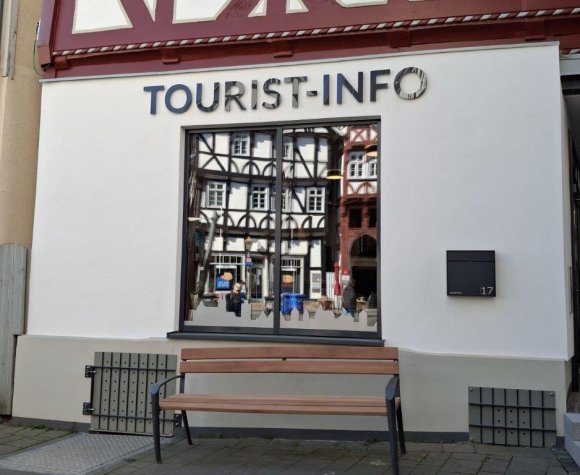
With the acquisition of the former Rolandsstuben building at Marktplatz 17, which is adjacent to the town hall, the town was able to set up a citizens' office and a tourist information centre in new premises.
Visitors and citizens can now receive advice in a barrier-free environment. With the new lift in the town hall, all floors are easily accessible.
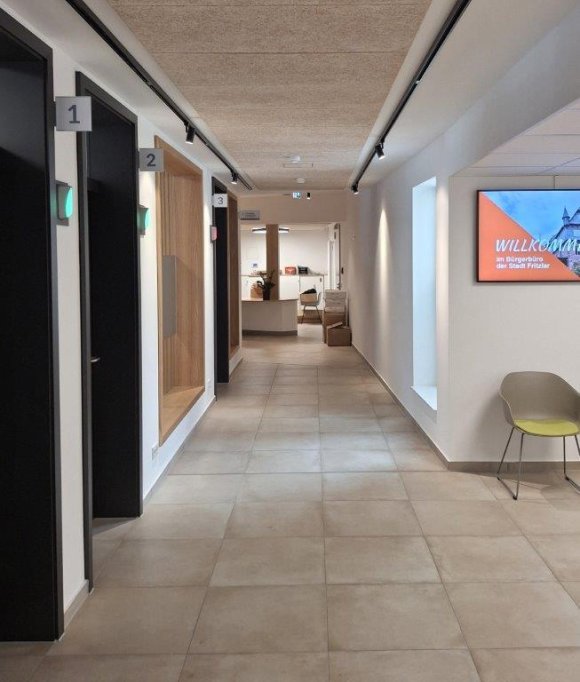
In the waiting area of the citizens' office, citizens and visitors can learn about the town's 1300-year history from timelines.
Afterword
2025
Fritzlar in the 21st century

Fritzlar is a great place to live!
1300 years of Fritzlar: turbulent times and destinies, also a reflection of German history.
The population and economic importance of the town have grown in recent decades.
Fritzlar is a regional centre and an important military location. The town offers a wide range of medical care, a broad range of educational opportunities, social facilities, natural living conditions and a rich cultural life.
The local court, police, volunteer fire brigade, German Red Cross, Maltese Relief Service and Technical Relief Service ensure law, security, order and assistance.
Clubs are involved in sports, culture, history and town twinning.
Since 1862, the horse market with its annual fair has attracted many visitors to Fritzlar.
With the carnival cry of ‘Alle Wille’ (come on everyone), several carnival societies celebrate during the carnival season. Thousands of people from the region come to the city for the Rose Monday parade.
The exciting events of the North Hesse Cultural Summer bring many people from the region together in front of St. Peter's Cathedral.
Imprint:
Provision of wall spaces in the citizen's office for the timelines on the history of Fritzlar: Magistrate of the city of Fritzlar
Authors: Michael Auerbach and Dr. Richard Gronemeyer
© 2025 Die Autoren
Historical and technical advice: Dr. Christian Wirkner, city archivist Fritzlar
Production: Volker Meier, L-D-F GmbH, Fritzlar; Layout: Nicole Beutel
The authors thank the sponsors of the timelines: Magistrate of the city of Fritzlar, Club ProFritzlar e.V., State of Hesse and Region Kellerwald-Edersee e. V.